THIS IS THE BLOG WHERE ARE THE THREE DIFFERENT LEVEL LINKS
http://teacherjuanvazquez.blogspot.com/
it won't happen again
miércoles, 17 de noviembre de 2010

domingo, 26 de septiembre de 2010
FAMILY TREE
VOCABULARY
father: papá
mother: mamá
son: hijo
daughter: hija
child: hijo(a)
children: hijos(as)
sibling: hermano(a)
siblings: hermanos y hermanas
cousin: primo(a)
distant cousin: primo(a) lejano(a)
uncle: tío
aunt: tía
nephew: sobrino
niece: sobrina
grandfather: abuelo
granpa: abuelito
grandmother, grandmamma: abuela
grandma: abuelita
grand-nephew: sobrino nieto
grand-niece: sobrina nieta
abuelos: grandparents
great-grandfather: bisabuelo
great-grandmother: bisabuela
great-great-grandfather, great-great-grandmother: tatarabuelo(a)
great-great-grandparents: tatarabuelos
godparents: padrinos
godfather: padrino
godmother: madrina
godchildren: ahijados
godson: ahijado
goddaughter: ahijada
adopted: adoptado(a)
orphan: huérfano(a)
to be left an orphan: quedar huérfano
widow: viuda
widower: viudo
single: soltero
divorced: divorciado
mate (br), buddy(am): cuate, compadre, amigo(a)
half-brother: medio hermano
half-mother: media hermana
stepmother: madrastra
stepfather: padrastro
stepsister: hermanastra
stepbrother: hermanastro
stepson: hijastro
to be married: estar casado
husband: esposo
wife: esposa (wives in plural form)
Father-in-law: suegro
Mother-in-law: suegra
Brother-in-law:cuñado
Sister-in-law: cuñada
father: papá
mother: mamá
son: hijo
daughter: hija
child: hijo(a)
children: hijos(as)
sibling: hermano(a)
siblings: hermanos y hermanas
cousin: primo(a)
distant cousin: primo(a) lejano(a)
uncle: tío
aunt: tía
nephew: sobrino
niece: sobrina
grandfather: abuelo
granpa: abuelito
grandmother, grandmamma: abuela
grandma: abuelita
grand-nephew: sobrino nieto
grand-niece: sobrina nieta
abuelos: grandparents
great-grandfather: bisabuelo
great-grandmother: bisabuela
great-great-grandfather, great-great-grandmother: tatarabuelo(a)
great-great-grandparents: tatarabuelos
godparents: padrinos
godfather: padrino
godmother: madrina
godchildren: ahijados
godson: ahijado
goddaughter: ahijada
adopted: adoptado(a)
orphan: huérfano(a)
to be left an orphan: quedar huérfano
widow: viuda
widower: viudo
single: soltero
divorced: divorciado
mate (br), buddy(am): cuate, compadre, amigo(a)
half-brother: medio hermano
half-mother: media hermana
stepmother: madrastra
stepfather: padrastro
stepsister: hermanastra
stepbrother: hermanastro
stepson: hijastro
to be married: estar casado
husband: esposo
wife: esposa (wives in plural form)
Father-in-law: suegro
Mother-in-law: suegra
Brother-in-law:cuñado
Sister-in-law: cuñada
My Family Tree
Using Have got and has got
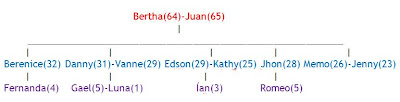
This is my family tree. Our family name's "Vazquez´s".
My father's name's Juan and my mother's name's Bertha.
Juan and Bertha both are sixty five years old.
Bertha and Juan have got five children.
Their names are: Berenice, Danny, Edson, Jhon and Memo.
Berenice is thirty two years old. She live's in Morelia. She's single and she's got a daughter. Her name's Fernanda. Fernanda is four years old.
Danny is thirty one years old and he is married. His wife's name's Vanne and she is twenty nine years old. They have got two children, Gael and Luna. Gael is five years old and Luna is about a year old. They live in Real de Tultepec
Edson is married with Kathy. Edson is twenty nine and Kathy is twenty five years old. They have got a baby. His name's Ían. He is three years old. They live in Cancun.
I'm twenty eight years old and i´m single too, but i've got girlfriend. I've got a baby. His name's Romeo. Romeo is five years old. We live with my parents in coacalco.
Memo is the youngest sibling. He is twenty six years old and he is married. His wife's name's Jenny and she's twenty three years old. They haven't got any children. They live in Coacalco, too.
Making sentences using 's and verb to be.
Bertha and Juan are Berenice's parents
Berenice's Bertha and Juan's daughter
Berenice's Danny's sister
Danny's Berenice's brother
Vanne's Berenice's sister-in- law
Fernanda is Berenice's daughter
Berenice's Fernanda's mother
Fernanda is Danny and Vanne's niece
Vanne and Danny are Fernanda's aunt and uncle
Gael is Fernanda's cousin
Gael is Berenice's nephew
Berenice's Gael's aunt
Bertha is Gael and Fernanda's grandmother
Gael and Fernanda are Bertha's grandchild
... Write 10 more sentences refereing to Edson, Kathy, Jhon, Memo, Jenny, Romeo, Ían and Bertha.
Using Have got and has got
This is my family tree. Our family name's "Vazquez´s".
My father's name's Juan and my mother's name's Bertha.
Juan and Bertha both are sixty five years old.
Bertha and Juan have got five children.
Their names are: Berenice, Danny, Edson, Jhon and Memo.
Berenice is thirty two years old. She live's in Morelia. She's single and she's got a daughter. Her name's Fernanda. Fernanda is four years old.
Danny is thirty one years old and he is married. His wife's name's Vanne and she is twenty nine years old. They have got two children, Gael and Luna. Gael is five years old and Luna is about a year old. They live in Real de Tultepec
Edson is married with Kathy. Edson is twenty nine and Kathy is twenty five years old. They have got a baby. His name's Ían. He is three years old. They live in Cancun.
I'm twenty eight years old and i´m single too, but i've got girlfriend. I've got a baby. His name's Romeo. Romeo is five years old. We live with my parents in coacalco.
Memo is the youngest sibling. He is twenty six years old and he is married. His wife's name's Jenny and she's twenty three years old. They haven't got any children. They live in Coacalco, too.
Making sentences using 's and verb to be.
Bertha and Juan are Berenice's parents
Berenice's Bertha and Juan's daughter
Berenice's Danny's sister
Danny's Berenice's brother
Vanne's Berenice's sister-in- law
Fernanda is Berenice's daughter
Berenice's Fernanda's mother
Fernanda is Danny and Vanne's niece
Vanne and Danny are Fernanda's aunt and uncle
Gael is Fernanda's cousin
Gael is Berenice's nephew
Berenice's Gael's aunt
Bertha is Gael and Fernanda's grandmother
Gael and Fernanda are Bertha's grandchild
... Write 10 more sentences refereing to Edson, Kathy, Jhon, Memo, Jenny, Romeo, Ían and Bertha.
domingo, 19 de septiembre de 2010

OBJECT PRONOUNS
We use Object pronouns to substitute the object of a verb (I study my notes [ the verb is study and the object is : my notes]) or to substitute the subject ( Person(s), animal(s), object(s) ) we are talking about. Sometimes the subject can be after a preposition (of, with, from, at...etc).
Examples
1. I'm cheking these examples now. --> checking is the verb and these examples (plural) are the objects
2. Where is Jhon? --> Jhon = subject
3. Where is your sister? She's with her boyfriend.
Although we are refering to the sister in the question, the principal subject (boyfriend) is in the answer. She's with her boyfriend. boyfriend is the principal subject in this sentence.
Now check the object pronouns for each personal pronoun below.
Personal Pronouns Object Pronoun
I ME
You YOU
He HIM
She HER
It IT
We US
They THEM
Now, substituting the last examples using the object pronouns we have:
1. I study my notes --> I study them (my notes = objects = plural = personal pronoun = They)
2. I'm checking these examples now --> I'm checking them (these examples = objects = plural = personal pronoun = They)
3. Where is Jhon? --> Where is him? (Jhon = Subject = Singular = personal pronoun = He)
4. Where is your sister? She is with her boyfriend --> She's with him ( boyfriend = subject = singular = personal pronoun = He)
5. I clean my bedroom every sunday morning --> I clean it every sunday morning (my bedroom = object = singular = personal pronoun = It)
Similar to Possessive Pronouns (mine, yours, his, hers... ) we use Object Pronouns when the object or subject is implicit. When we are watching the object(s)/subject(s) or when we know what the object(s)/subject(s) are refered to.
Exercise 1
Substitute the object with the correct object pronoun
1. I call my daughter everyday
2. I clean my windows every weekend
3. He washes his car every Saturday
4. I have to clean my room
5. You have to check this mistake
6. We are answering these exercises
7. I need this cd now
8. She's studying with Jesus and Joan
9. She is calling Mary right now
10. They are talking to their friends right now
11. She types letters
12. I want the copies tomorrow
13. I play soccer with my friends everyday
Vocabulary
substitute: sustituir
to: para
talk about: hablar sobre (algo)
can be: puede estar
after: después
although: a pesar de que...
refer to: referirse a, hacer cita a
answer: noun= respuesta. verb= responder
each: cada
are refered to: son citados
daughter: hija
wash: lavar (washes --> 3rd person)
clean: limpiar
room: cuarto
mistake: error
have: tener (posesión, deber)
need: necesitar
with: (preposition) con
call: llamar --> calling = Gerund form
answer: responder
talk: hablar
type: escribir a máquina
Examples
1. I'm cheking these examples now. --> checking is the verb and these examples (plural) are the objects
2. Where is Jhon? --> Jhon = subject
3. Where is your sister? She's with her boyfriend.
Although we are refering to the sister in the question, the principal subject (boyfriend) is in the answer. She's with her boyfriend. boyfriend is the principal subject in this sentence.
Now check the object pronouns for each personal pronoun below.
Personal Pronouns Object Pronoun
I ME
You YOU
He HIM
She HER
It IT
We US
They THEM
Now, substituting the last examples using the object pronouns we have:
1. I study my notes --> I study them (my notes = objects = plural = personal pronoun = They)
2. I'm checking these examples now --> I'm checking them (these examples = objects = plural = personal pronoun = They)
3. Where is Jhon? --> Where is him? (Jhon = Subject = Singular = personal pronoun = He)
4. Where is your sister? She is with her boyfriend --> She's with him ( boyfriend = subject = singular = personal pronoun = He)
5. I clean my bedroom every sunday morning --> I clean it every sunday morning (my bedroom = object = singular = personal pronoun = It)
Similar to Possessive Pronouns (mine, yours, his, hers... ) we use Object Pronouns when the object or subject is implicit. When we are watching the object(s)/subject(s) or when we know what the object(s)/subject(s) are refered to.
Exercise 1
Substitute the object with the correct object pronoun
1. I call my daughter everyday
2. I clean my windows every weekend
3. He washes his car every Saturday
4. I have to clean my room
5. You have to check this mistake
6. We are answering these exercises
7. I need this cd now
8. She's studying with Jesus and Joan
9. She is calling Mary right now
10. They are talking to their friends right now
11. She types letters
12. I want the copies tomorrow
13. I play soccer with my friends everyday
Vocabulary
substitute: sustituir
to: para
talk about: hablar sobre (algo)
can be: puede estar
after: después
although: a pesar de que...
refer to: referirse a, hacer cita a
answer: noun= respuesta. verb= responder
each: cada
are refered to: son citados
daughter: hija
wash: lavar (washes --> 3rd person)
clean: limpiar
room: cuarto
mistake: error
have: tener (posesión, deber)
need: necesitar
with: (preposition) con
call: llamar --> calling = Gerund form
answer: responder
talk: hablar
type: escribir a máquina
jueves, 16 de septiembre de 2010




domingo, 12 de septiembre de 2010
5IM6
 cualquier duda o aclaracion... busquenme en el lab 2 de inglès de 10 a 14 mañana y el martes de 12 a 14 siempre y cuando haya realmente algùn punto que no haya tomado en cuenta respecto a tu calificaciòn.
domingo, 5 de septiembre de 2010
PREPOSITIONS OF TIME
IN
MONTHS
in September, in October, in November...
YEARS
in 1982 [in nineteen eighty two], in 1586 [in fifteen eighty six], 2002 [two thousand and two], in 2010 [in two thousand and ten]
HOURS
in three hours, in one hour, in ten hours
SEASONS
in (the) winter, in (the) spring, in (the) summer, in (the) autumm or in (the) fall
MOMENTS
in the morning, in the afternoon, in the night--> it rained in the night, in years --> I haven't seen her in years, for the first time in years
ON
DATES
My birthday is on September 18th (on september eighteenth / on the eighteenth of September)
I have to go to Italy on October 20th
I was born on September 18th, 1982 at 2:00 in the morning (on the eighteenth of September, nineteen eighty two at two o´clock... / on September eighteenth, nineteen eighty two at two o'clock...)
DAYS
on Monday, on Tuesday, on Christmas day, on weekdays, on weekend
MOMENTS
on that occasion, on the hour (every hour), on the way to --> I met her on the way to the store
AT
at night, at noon, at midnight, at dawn, at midday, at lunchtime, at christmas, at a later date, at te beginning / end, at the end of the year, at regular intervals, at a god time.
ABOUT
Years, Age or Time
She's about thirty, it was about six years ago
HOUR
at about one o'clock
Expression: About time!
VOCABULARY PROPOSED
seasons: temporada
winter: invierno
spring: primavera
summer: verano
autumm / fall: otoño
past: pasado
rained: the past of rain, llover
I haven't seen her: No la he visto
for the first time in years: por primera vez en muchos años
every: cada
weekdays: dias de la semana / entre semana
at a later date: en una fecha posterior
beginning: principio
at the end of the year: a finales de año, al final del año
at regular intervals: en diferentes intervalos
noon / midday: medio día
midnight: media noche
at a good time: en un momento oportuno
on the way to: camino a
about time!: ¡Ya era hora!
MONTHS
in September, in October, in November...
YEARS
in 1982 [in nineteen eighty two], in 1586 [in fifteen eighty six], 2002 [two thousand and two], in 2010 [in two thousand and ten]
HOURS
in three hours, in one hour, in ten hours
SEASONS
in (the) winter, in (the) spring, in (the) summer, in (the) autumm or in (the) fall
MOMENTS
in the morning, in the afternoon, in the night--> it rained in the night, in years --> I haven't seen her in years, for the first time in years
ON
DATES
My birthday is on September 18th (on september eighteenth / on the eighteenth of September)
I have to go to Italy on October 20th
I was born on September 18th, 1982 at 2:00 in the morning (on the eighteenth of September, nineteen eighty two at two o´clock... / on September eighteenth, nineteen eighty two at two o'clock...)
DAYS
on Monday, on Tuesday, on Christmas day, on weekdays, on weekend
MOMENTS
on that occasion, on the hour (every hour), on the way to --> I met her on the way to the store
AT
at night, at noon, at midnight, at dawn, at midday, at lunchtime, at christmas, at a later date, at te beginning / end, at the end of the year, at regular intervals, at a god time.
ABOUT
Years, Age or Time
She's about thirty, it was about six years ago
HOUR
at about one o'clock
Expression: About time!
VOCABULARY PROPOSED
seasons: temporada
winter: invierno
spring: primavera
summer: verano
autumm / fall: otoño
past: pasado
rained: the past of rain, llover
I haven't seen her: No la he visto
for the first time in years: por primera vez en muchos años
every: cada
weekdays: dias de la semana / entre semana
at a later date: en una fecha posterior
beginning: principio
at the end of the year: a finales de año, al final del año
at regular intervals: en diferentes intervalos
noon / midday: medio día
midnight: media noche
at a good time: en un momento oportuno
on the way to: camino a
about time!: ¡Ya era hora!
Suscribirse a:
Entradas (Atom)